Project case study · Alternative learning architecture
REAL Neural Substrate
A standalone research prototype testing whether useful computation can emerge from local agents adapting under metabolic pressure, with learning written into inspectable structure rather than a global gradient.
The question
Can learning live in local relationships instead of a global loss?
REAL—Relationally Embedded Allostatic Learning—asks what changes when computation is distributed across agents that know only their local state, pay for activity, and must preserve enough regulation to keep acting.
The aim is not to rename a conventional network. Learning should appear in persistent substrate: memory supports, routing bias, edge weights, and structural changes that carry forward into later decisions and can be inspected directly.
The system
What holds it together
Local knowledge only
Each agent acts from available state and relationships. There is no privileged global observer supplying a universal view of the problem.
Computation has a cost
ATP-style budgets make prediction, selection, routing, and structural support part of the system's regulatory problem.
Learning changes structure
Experience is expected to alter persistent substrate rather than disappear into an opaque training step outside the agents' world.
Inspect the mechanism
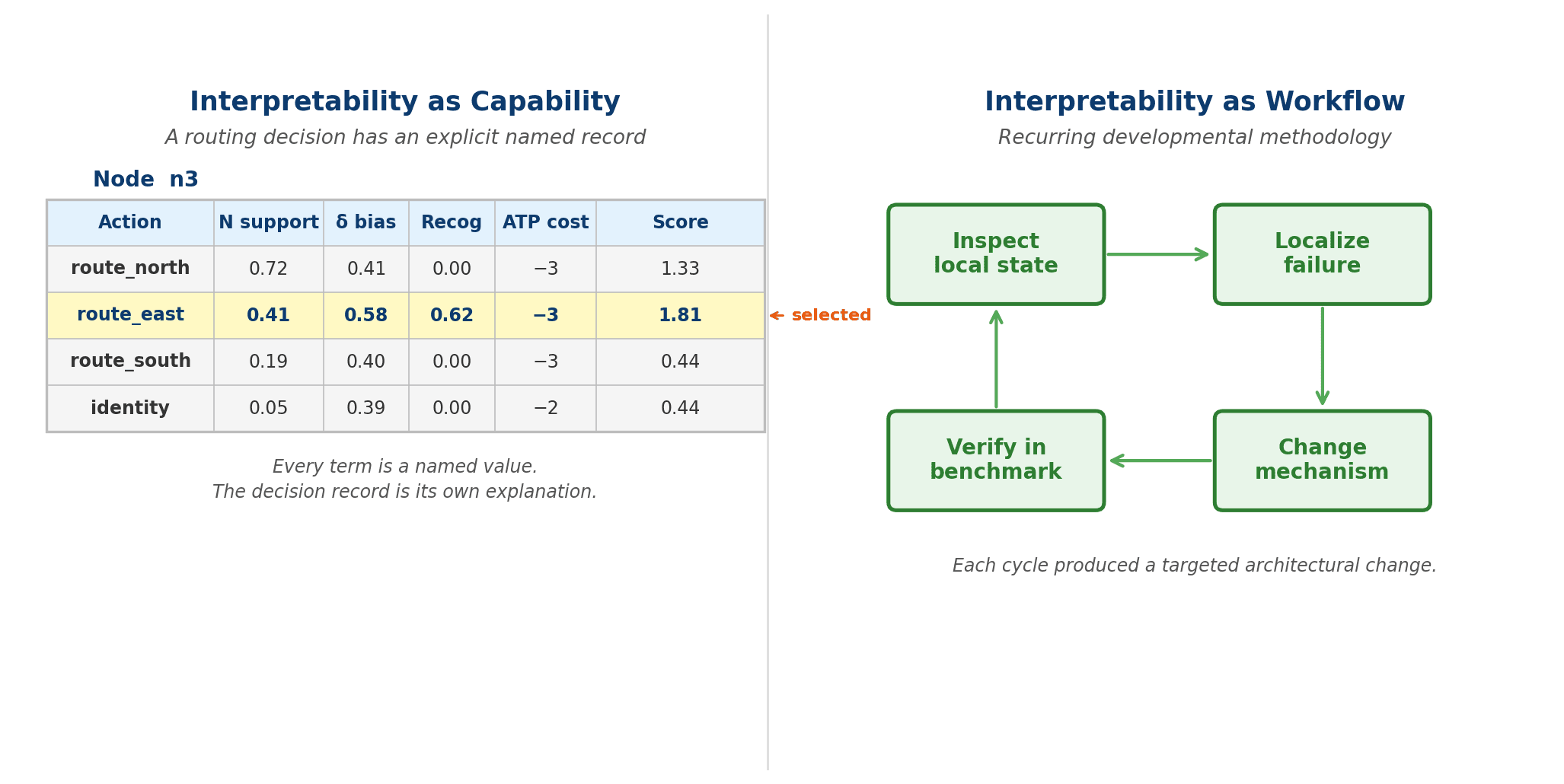
Named decision terms, counterfactual toggles, and preserved null results make architectural failure a source of information.
How it moves
A local loop that can leave a trace
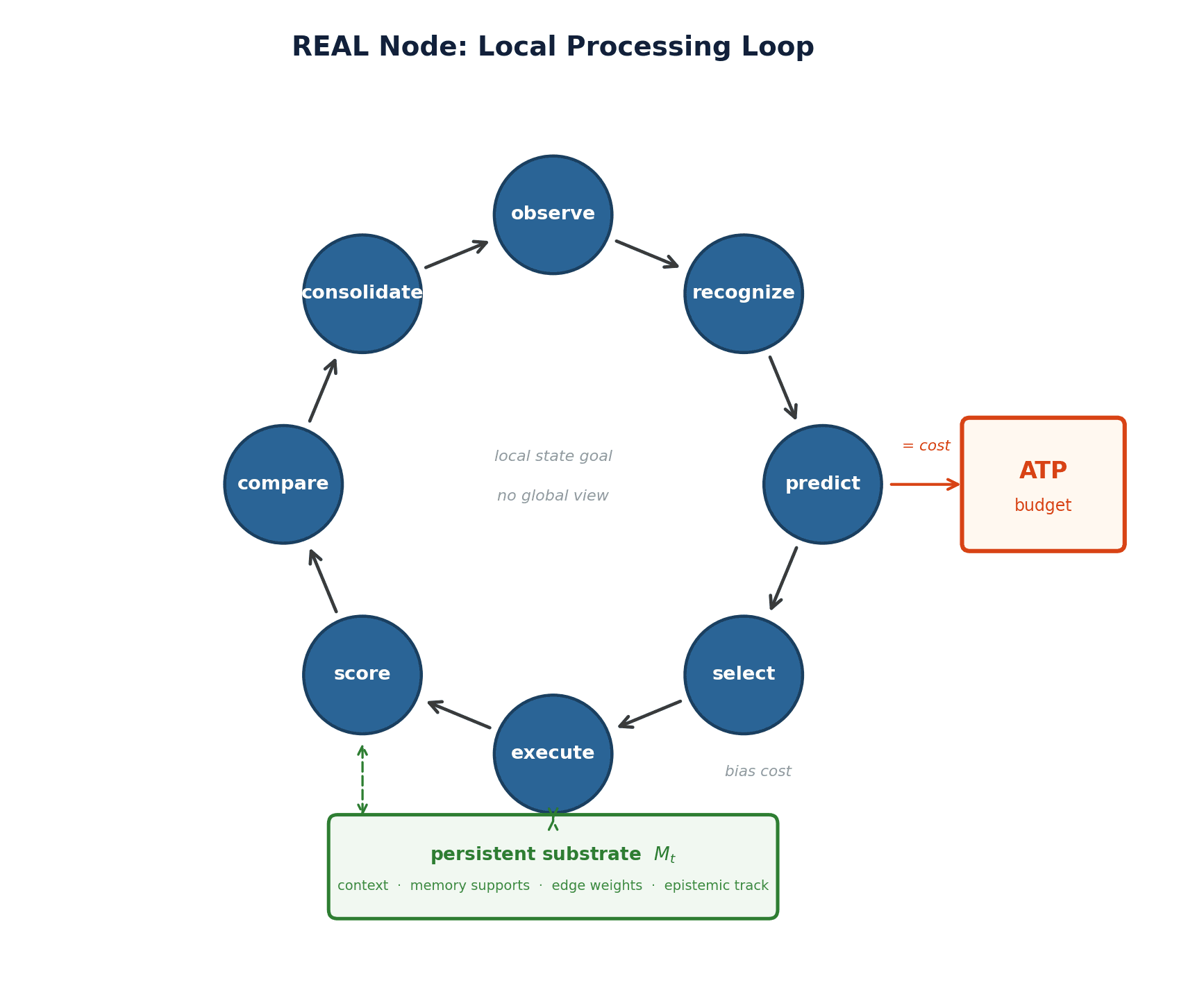
The generalized engine and the native multi-agent substrate share a recurring cycle while keeping task adapters and experiments outside the core.
- Observe
Recognize the current situation
An agent reads local state, identifies familiar structure, and forms a prediction without access to the entire system.
- Select
Choose under constraint
Candidate actions combine support, bias, recognition, and metabolic cost in an explicit decision record.
- Compare
Score the encountered result
Execution produces a local consequence that can be compared with the agent's prediction and regulatory goal.
- Consolidate
Write experience into substrate
Memory supports, connections, and routing structure can change so later behavior carries a material trace of earlier experience.
Synthetic occupancy dataset · March 2026
Fresh-session evaluation
Warm advantage was not universal
What the research is becoming
A program where failed mechanisms still teach
REAL matters to me as much for its method as for its architecture. A mechanism should be visible enough to disable, probe, and compare. If it fails to help, that null result narrows the next question instead of disappearing behind a summary metric.
The current repository is an active prototype rather than a polished library. Its value is the growing connection between a generalized local-learning loop, a native multi-agent substrate, and experiment harnesses that preserve the conditions under which each result appeared.
Nearby in the constellation
Connected threads
Emergence Engine
Both examine learning as embodied relational adaptation.
informsPsychocompugenics
The conceptual framework supplies questions about cognition and experience.
shares feedback loopACE
Both connect action, state, and feedback over time.
shares themeEmergence Lab
Both make local behavior and its collective consequences inspectable, with different educational and research purposes.