Project case study · Artificial-life simulation
Emergence Engine
An interactive ecology where adaptive agents forage, learn, reproduce, and respond to human participation as local rules accumulate into collective behavior.
The question
What appears when behavior is not scripted?
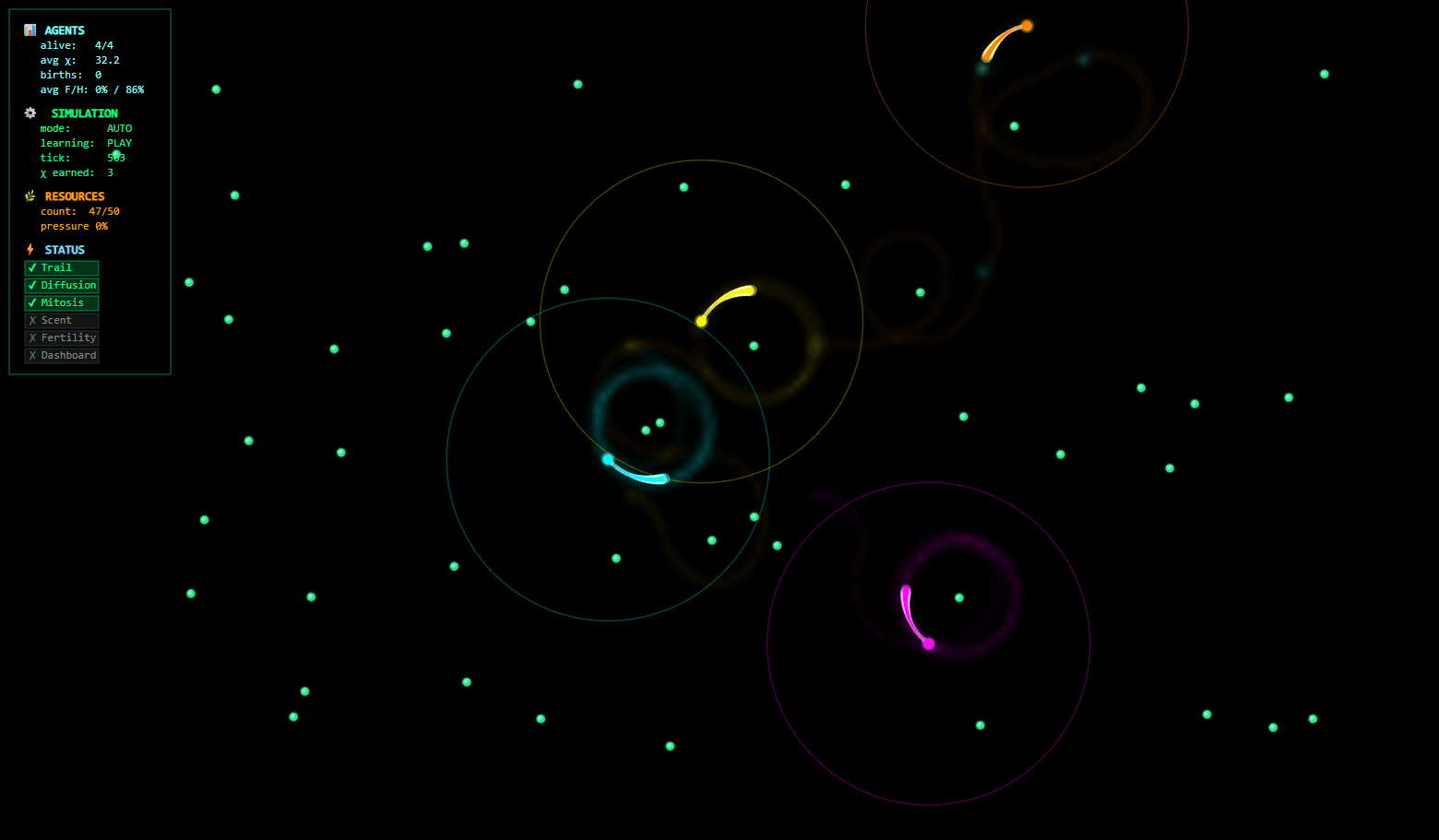
Emergence Engine starts with small, embodied agents—bundles—that must move, sense, spend energy, find regenerating resources, and sometimes reproduce. No single rule contains the behavior of the whole field.
Instead of directing the outcome, the simulation makes the conditions adjustable and lets patterns accumulate. Trails become memory in the environment. Scarcity reshapes motion. Reproduction changes the pressure on the ecology. Learning modifies how future agents move through it.
The system
What holds it together
Embodied agents
Movement, sensing, energy, and survival keep intelligence attached to a body acting inside a world rather than floating above it.
A changing ecology
Resources regenerate through fertility and carrying capacity, so the environment responds to the population consuming it.
Participation, not command
Resource, distress, and bonding fields let a person influence the system without directly choosing each agent's next action.
Learning you can inspect
Cross-Entropy Method training, saved policies, overlays, and an analysis dashboard expose how behavior changes across runs.
How it moves
A loop for watching complexity grow
The simulation is both an experience and an instrument: a place to intervene, observe, compare, and form the next question.
- Seed
Define the conditions
Configure ecology, metabolism, sensing, movement, reproduction, reward, and the limits of the shared field.
- Observe
Watch local decisions accumulate
Agents forage and leave trails while overlays reveal sensing ranges, fertility, gradients, and population state.
- Participate
Disturb the system gently
Human-created influence fields attract, signal distress, or encourage bonding while preserving agent autonomy.
- Learn
Compare behavior across generations
Training evaluates policies, retains stronger candidates, introduces variation, and records the resulting trajectories.
Resource · distress · bond
Policy search across generations
Overlays, trails, metrics, and controls
Why I keep returning to it
Design the conditions. Let the system answer.
Emergence Engine reflects a recurring question in my work: how much complexity can arise from relationships, constraints, and feedback before we need to impose a central plan? The simulation makes that question visible and playable.
Its future directions—memory, personality, multiple species, richer evolution, and conversational experimentation—remain possibilities rather than promises. The current work is the foundation: a concrete world where those ideas can eventually be tested.
Nearby in the constellation
Connected threads
REAL Neural Substrate
Both examine learning as embodied relational adaptation.
shares methodCondition Map
Both expose interacting conditions so users can inspect how behavior changes.
shares experimental spiritFOSL
Both turn complex technical systems into visible, interactive experiments.
adaptsEmergence Lab
Emergence Lab turns the open ecology into guided lessons with predictions and controlled comparisons.